Concern for the overuse of worming chemicals in all animals has never been higher. Not only is reckless treatment causing rapid resistance problems, but research reveals the devastating effects they wreak on our environment.
Anthelmintics, worming drugs, are essentially poisons. These chemicals are excreted in the horse's manure following treatment and can persist in the environment for extended periods, affecting invertebrates like dung beetles and other microorganisms and potentially harming aquatic life.
Of our five licenced wormers for horses, ivermectin is the most toxic to dung beetles and moxidectin moderately toxic while pyrantel, fenbendazole and praziquantel are significantly less poisonous.
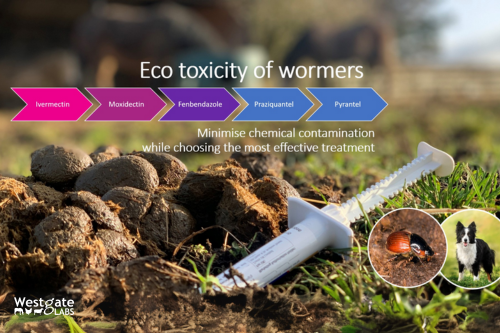
It’s estimated that between 80 to 98% of an oral dose of ivermectin passes straight through the horse and is excreted in the dung without being metabolised by the body. Once in the environment it’s also one of the most resilient chemicals, persisting at high concentrations in faeces for many weeks.
Faecal excretion times
For the 5 different anthelmintic chemicals used in equine de-worming:
- Fenbendazole (Panacur) and Pyrantel (Strongid P, Pyratape) – peak faecal excretion 24 hours after administration, with complete excretion by 72 hours.
- Praziquantel (purchased from the vet) is an extensively metabolised compound in horses with most of the chemical excreted in urine, and faeces, within 24 hours. 31% of the administered dose excreted in urine and 24% excreted in faeces within 24 hours as various metabolites.
- Ivermectin (Eqvalan, Eraquell & Noromectin) and Moxidectin (Equest) significantly longer with peak excretion within 2.5 days after administration, tailing off so that for Ivermectin, 90% of the dose is excreted within 4 days of administration. Ivermectin can be detected in dung as long as 40 days after application.
- Moxidectin, which is absorbed in body fat, the maximal concentrations in the faeces are reached approx. 2.5 days after application. About 90% of the dose is eliminated within 8 days after application, with moxidectin being able to be detected in dung up to 75 days after administration.
Some chemicals are combined in some anthelmintics too: Moxidectin & Praziquantel (Equest Pramox) and Ivermectin & Praziquantel (Equimax and Eqvalan Duo).
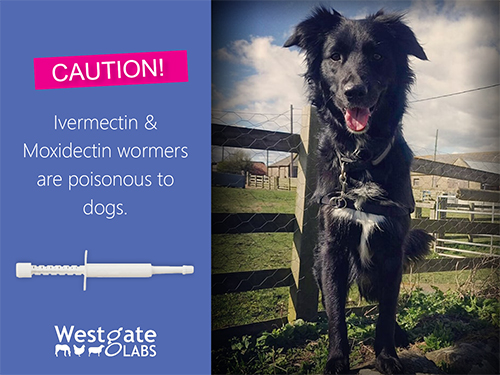
Be especially careful when using Ivermectin which is toxic to dogs and particularly is not well tolerated by Collies, Old English Sheep Dogs and their related breeds and crosses.
'When ivermectin is applied orally to horses, the maximal concentrations in the faeces are reached approx. 2.5 days after application. Ivermectin can be detected in faeces as long as 40 days after appli-cation. However, about 90% of the applied dose is eliminated via faeces within 4 days after application (Pérez et al. 2001).'
The data sheet for Equest Pramox says: “In order to limit the impact of moxidectin on dung fauna and due to insufficient data regarding environmental risk of praziquantel horses should not be turned out onto pasture within three days of treatment.”
Tips to Reduce Contamination
- To prevent contamination bring the horse onto a surfaced area to administer the wormer, that can be easily cleaned if necessary - rather than worm him in the field. Dispose of packaging carefully, preferably in a bin with a lid.
- Following treatment, minimise the horse’s time on the pasture for up to 10 days and poo pick at least daily during this time. The more eco-toxic the chemical you’re using, the more diligent you should be.
- If you can only stable for a short time, advice is to keep horses in the day following worming. It may also help to restrict treated horses to a smaller paddock for 10 days to aid dung collection - this also applies to horses living out 24/7.
- Dung collected from treated horses can be placed in carefully situated manure piles, safe from dogs, and allowed to rot down. Research has shown thermophilic composting (where the centre of the pile reaches a min 60 °C) will cause even ivermectin to break down almost entirely after a few weeks.
- The main environmental risk from muckheaps comes from the impact of residues in rainwater run-off leaching into soils and watercourses. They should be positioned at least 3m outside of fields to prevent hatching larvae re-contaminating grazing land and away from areas of surface groundwater, field drains and not within 10 metres of a watercourse. In an ideal world cover your muck heap with a roof/tarp to reduce the risk of run-off.
- Manure should not be spread back on the land for at least 6 months. By then concentrations of parasiticides should be low and worm eggs much reduced to minimise reinfection.